
 Print
Print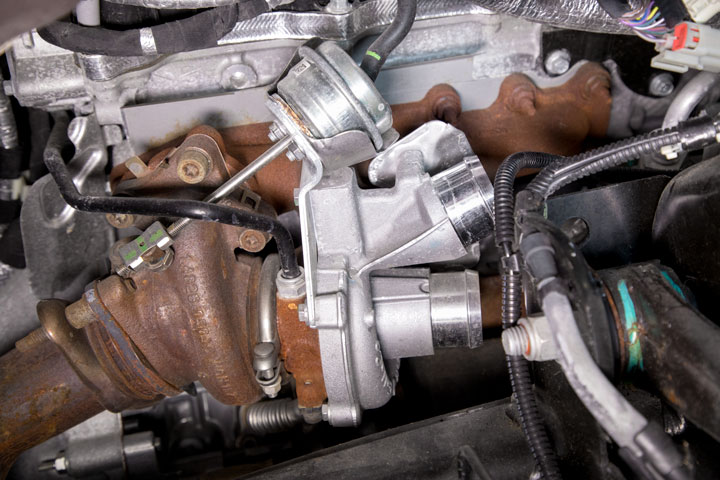
In this series, we look at several methods used to boost fuel economy, different considerations to repair them, and any special precautions the collision repair industry needs to know. Let’s look at turbochargers.
Tightening regulations on fuel economy along with rising awareness about pollution have influenced vehicle design and function in recent years. However, most consumers are not willing to sacrifice comfort, vehicle size, of power, so auto makers needed to use different methods to boost the fuel economy numbers. For the most part, aerodynamics can be directly related to fuel efficiently. The smoother air flows over the vehicle, the less power is required to make the vehicle move, leading to higher fuel economy. Unfortunately, a vehicle that has excellent aerodynamics may not be a functional vehicle for every consumer. So, other measures needed to be taken.
Turbocharged engines are not a new technology. They have been around for many years to help create more power from engines. Turbochargers are still used to make large amounts of power, but the reason for the power is different for many vehicles. Many consumers want good fuel economy but are not willing to sacrifice acceleration or power. So, the options used to be to put a big engine in a vehicle to get a lot of power and bad fuel economy, or utilize a small engine and sacrifice power while getting great fuel economy.
In recent years, automakers have solved this problem by using turbocharged engines. This way the vehicle can use a smaller fuel-efficient engine but it doesn’t mean power needs to be sacrificed. The turbo charger makes the smaller engine produce as much or more power than a larger engine.
So, how does a turbocharger system work and how does it create more power? One of the three crucial components of combustion is air or oxygen to be specific. The more oxygen that is in the cylinder during combustion the more power will come from the explosion. This is great in theory, but more air will require more fuel. So where does the economy come from? The ability to put a smaller, lighter engine generating relatively the same power as a big engine. When weight is removed from the vehicle it will require less power to move the vehicle, thus increasing fuel economy.
A turbo system uses two different methods to maximize the amount of oxygen that can enter the combustion chamber. The first step is the turbo. The turbo uses two separate chambers with an impeller on each side. The impellers are attached together with a shaft. Exhaust gases pass through one side on its way out of the engine. The pressure of the exhaust moving over the impeller causes it to spin at high speeds. This causes the other side to spin. This side sucks in intake air. The spinning impeller on the intake side works as an air compressor, packing a large amount of oxygen into a smaller space.
When air is compressed though, it heats up. Hot air is in a more expanded state of matter, so it holds less oxygen than colder air would. For this reason, the compressed air passes through a heat exchanger called an intercooler. The air cools as it passes through, so the oxygen is packed into an even smaller space. This allows a significant amount more oxygen to enter the combustion chamber, causing a better burn.
The last major component is the wastegate, this allows excessive pressure from the exhaust to bypass the turbo so too much compressed air pressure isn’t produced. The main piece of a turbo charged powertrain that collision repair facilities will handle is the intercooler and the intercooler piping. The intercooler is normally placed in the front of the vehicle, where damage commonly occurs. The pressure produced by the systems make it important to make sure all the clamp holding the piping together are properly tightened. Turbocharged engines with the exhaust manifold located in the front are also susceptible to wastegate and turbocharger damage in a substantial front-end collision. Always consult the service manual before repairing the turbo charger system.
Always research repair procedures to make sure that all repairs are being performed according to the manufacturer. If these systems are not properly functioning after a collision, the vehicles fuel economy may be sacrificed, which leads to an unsatisfied customer. Though this system may not pose a safety concern, it can cause a problem with fuel efficiency, emissions, and customer satisfaction.
Additional I-CAR Collision Repair News you may find helpful:
Related I-CAR Courses
Article validated in 2026