 Print
Print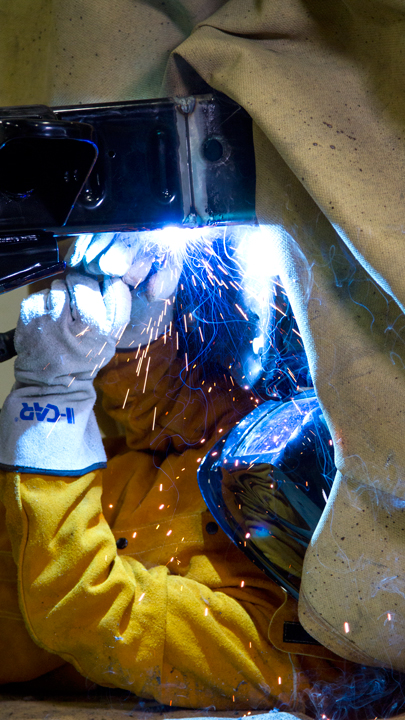
Article originally appeared in FF Journal March, 2014 - By Gretchen Salois
After an accident, reassuring repair work is essential.
March 2014 - A vehicle is a means to get from Point A to Point B. After an accident, it is necessary to make sure any repairs made uphold the vehicle’s integrity, ensuring it continues to serve as a protective means of transportation. To achieve that end, collision repair industry professionals doing the repair work can complete certification programs that reinforce welding procedures and quality work.
While welding certification programs aren’t new to the automotive industry, interest is on the rise as newer vehicles come off the assembly line with different mixtures of steel and lighter weight aluminum. “The industry is recognizing the mixed metals in newer vehicles, the high percentage of aluminum and the gap between that knowledge and lack of training,” says Elise Quadrozzi, director, segment development – insurance at I-CAR.
I-CAR offers training and certification programs and has delivered training for OEMs such as Ford, Volvo, Toyota, and GM. I-CAR training provides workers with consistent training, ensuring collision repair technicians are equipped with the knowledge and skills needed to provide complete, safe and quality repairs.
“We’ve trained thousands of technicians in the last 15 years,” says Jason Bartanen, I-CAR director of industry technical relations. I-CAR’s latest partnership with State Farm insurance is an example of efforts to streamline training.
“I-CAR serves a segment of the industry that serves everyone in the supply chain—from OEMs, shops and insurers—everyone possesses the ability to make sure everyone is properly trained,” Quadrozzi says. “Not just with welding but all kinds of other repair training.”
Educating Repairers
The welding programs that I-CAR offers begins with a welding capability readiness assessment. “There’s a hands-on evaluation by an instructor that looks at gear and equipment and goes through a check list to make sure students have everything they need to be successful in the program,” Quadrozzi says. “The actual course training is divided into knowledge assessment, theory, how to set up machines, prep work, and then actually performing the welding tests on multiple thicknesses of material, and in two positions; vertical and overhead, similar to performing welds on a vehicle.” Students are also coached to make sure they are going through it properly, demonstrating knowledge by taking the test.
The majority of I-CAR’s certification focuses on MIG welding, but I-CAR also offers hands-on training for squeeze-type resistance spot welding. Due to the higher strength steels found on today’s vehicle, STRSW is becoming a preferred method for repair.
“Much like manufacturers building a car, we’re using a lot of spot welding to do repairs,” says Bartanen. “Next is possibly moving into more MIG brazing weld training and certification, as there are more high- and ultra-high strength steels being used by car manufacturers that are increasingly heat sensitive. We can’t use GMA MIG welding on some of the high- and ultra-high-strength steels, but we will continue to use that on many of the mild steels.”
I-CAR has worked with the American Welding Society on its GMAW welding programs, but differs in that AWS works with a lot of thicker materials. “They’re dealing with much thicker steel than we’ll find on today’s automotive structures,” Bartanen says.
Learning the latest in welding for automotive repair prepares those trained for positions with companies looking for workers who have met certain requirements. “Our certification programs stand on their own and when shops are looking to hire, they want someone with professional development certification versus someone who has not had that training,” Quadrozzi says. “So we also include role-based training so it’s specific to automotive welding. The welding program is incorporated into I-CAR’s flagship Professional Development Program concerning collision.
“We serve a number of constituents and listen to the voice of the customer,” Quadrozzi continues. “Based on what’s happening within the industry, as vehicle technology evolves, both from a technological and metals perspective, we too have to continue to evolve and grow. We’re ever expanding and growing just as the industry continues to.”
Article validated in 2025